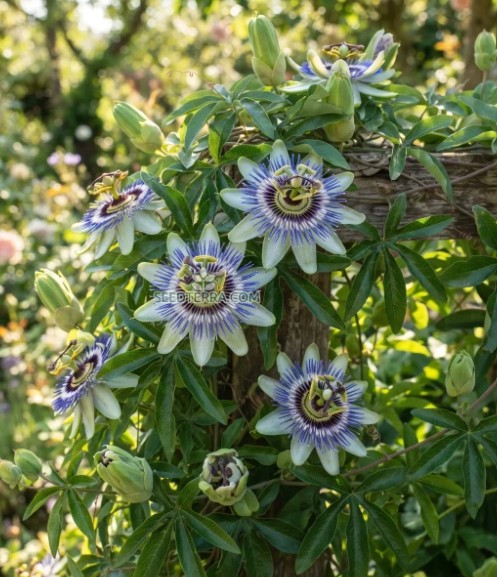
BLUE PASSION FLOWER; Passiflora Caerulea (South America)
Passiflora caerulea, commonly known as the blue passion flower, is a vigorous, fast-growing climbing vine famous for its intricate, star-shaped blossoms featuring white petals and a radiant corona of blue, purple, and white filaments.
- Origin: Native to South America (Brazil, Argentina, Paraguay, Uruguay).
- Size: Reaches 10 to 40 feet (3 to 12 meters) tall with a spread of 3 to 6 feet.
- Hardiness: Generally hardy in USDA Zones 6–10, often acting as an evergreen in warm regions and dying back to the roots to regrow in cooler temperate zones.
- Flowers & Fruit: Blooms from summer to fall, producing complex 3- to 4-inch flowers followed by egg-sized, deep-orange, edible (though somewhat bland) berries.
- Growth Habit: Utilizes flagellate-twining tendrils and can send out vigorous underground runners or suckers.
- Light: Thrives in full sun to partial shade.
- Soil: Adapts well to clay, loam, or sandy soils as long as they have good drainage.
- Water: Requires regular watering to establish, preferring moist, fertile, and high-humidity environments.
- Support: Needs a sturdy structure like a trellis, fence, or arbor to climb.
- Pruning: Can be pruned heavily in the spring after the threat of frost has passed to control its vigorous spread. You can explore options or purchase plants from specialty growers like Brushwood Nursery or read detailed profiles on the Missouri Botanical Garden Plant Finder.
Care Requirements